By Sara Perez Webber
What does it take to grow a catering business when labor and food costs are rising, clients expect more, and technology is changing the way companies operate?
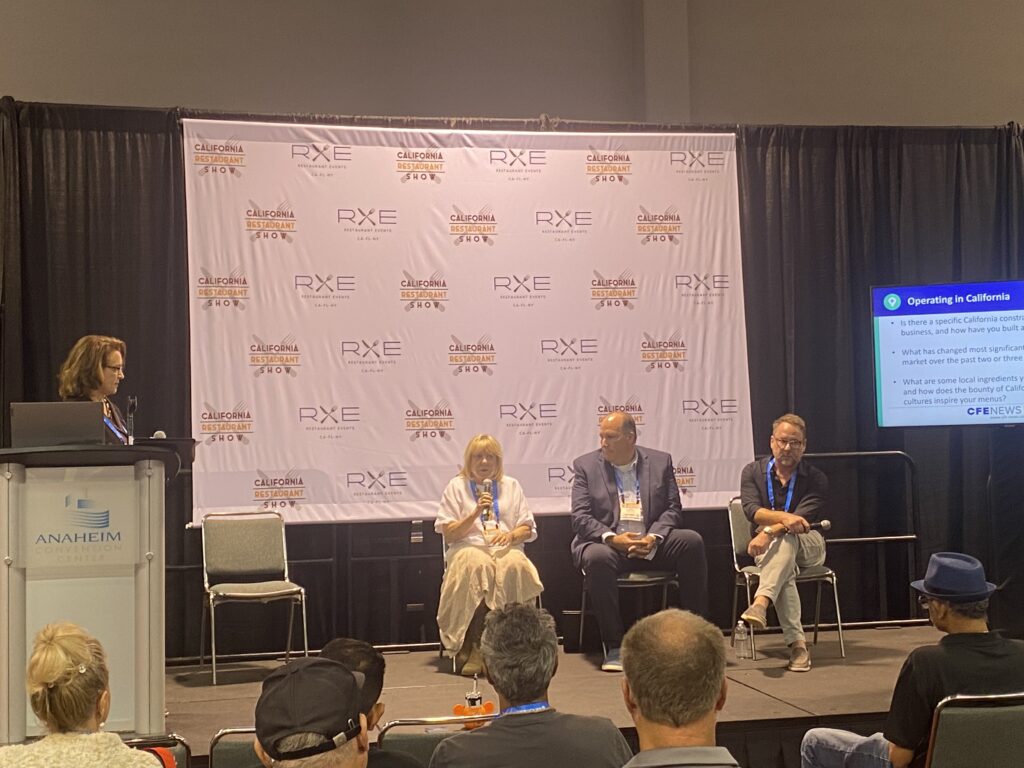
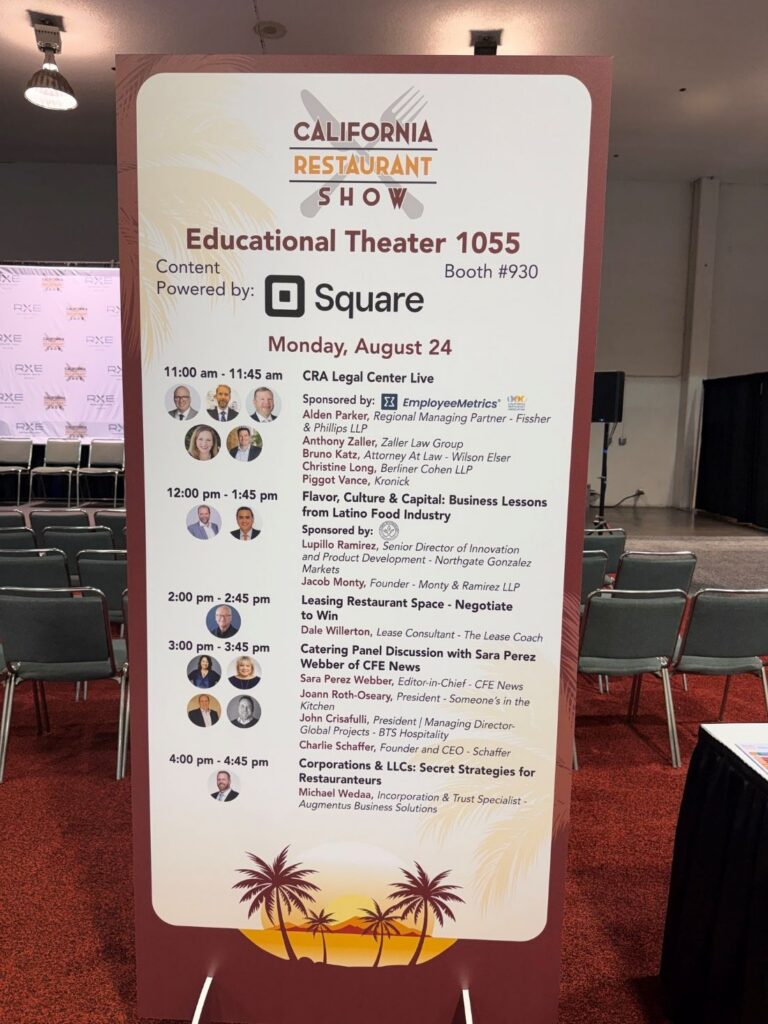
At the California Restaurant Show in August, CFE News Editor-in-Chief Sara Perez Webber moderated a panel discussion exploring those questions and more with three veteran catering executives: John Crisafulli, president and managing director-global projects at BTS Hospitality in San Diego; Joann Roth-Oseary, president of Someone’s in the Kitchen in Tarzana; and Charlie Schaffer, founder and CEO of Schaffer in Los Angeles.
The wide-ranging conversation covered everything from California’s unique marketplace and changing sources of growth to technology, sales and the importance of building lasting client relationships.
California Challenges—and Opportunities
California’s complex regulations present significant challenges for catering businesses, particularly as they grow and expand beyond state lines.
Roth-Oseary—who’s been in catering for 42 years—is involved in advocacy efforts through the California Business & Industrial Alliance (CABIA), which is working to create a more business-friendly climate. “The biggest challenge of being an employer in the state of California is the labor law regulation,” she said. “The food is easy, the clients are easy, everything else is easy.”
Crisafulli—who founded BTS nearly 37 years ago—has also joined the fray, meeting with the State Board of Equalization regularly and pointing out the less burdensome laws in other states he operates in. “You can’t just sit and take it, because that’s how we got where we are today,” he advised. “Be vocal, because you’ll get them to listen if you push hard enough.”
Schaffer, who launched his company in 2008, praised the work of CABIA and said it’s helped to curb some of the government overreach. Echoing Crisafulli, he noted that California’s labor and compliance laws travel with caterers working elsewhere, making it harder to be competitive when working in other states.
However, Schaffer sees a bright side: “If we can be better than our competitors at [compliance], that gives us a bit of an advantage. So what we’ve done is build a really solid back room that helps us handle a lot of these things and stay ahead of them.”
Strong Demand in the Golden State
Despite the challenges, the panelists emphasized California’s considerable advantages, including a year-round event calendar, strong tourism and convention business, and easy access to fresh, locally grown ingredients. “We have the best weather in the United States,” noted Crisafulli. “And we have amazing farms and produce and suppliers all over the state that are very excited to participate in farm-to-table concepts.”
It helps, noted Schaffer, that “every brand in the world wants to have a presence in Southern California.”
Relationships Drive Growth
While finding new business is essential, the panelists agreed that lasting relationships are among the most effective drivers of growth.
For Schaffer, that means treating clients as partners. “Approaching all of our clients with that mentality has been key for us,” he said. Close collaboration results in ongoing business with clients, rather than one-off bookings.
The philosophy has reshaped his company’s sales process. Rather than responding to every inquiry with a proposal, the Schaffer team first conducts in-depth discovery calls that typically include both sales and operations representatives. After determining if the client and the event are a good fit, the company can deliver a customized proposal—without wasting time on leads that go nowhere.
For Roth-Oseary, relationships have translated into decades of repeat business, including catering celebrations for multiple generations of the same family. She soon will be catering a bat mitzvah for a woman whose own bat mitzvah she catered years earlier, at the same location.
Whether its longtime clients or longtime employees, “we’ve all grown up together, which is really wonderful,” she said. “It all has to do with the relationships you create. You’re selling hot dogs, and I’m selling hot dogs. But if your client knows how invested you are in the success of their event, they’re going to buy your hot dog.”

Sources of New Business
The panelists identified several promising areas of business, from corporate events to entertainment and branded experiences.
Crisafulli, whose company began as a backstage caterer for concerts, pointed to growing opportunities in live entertainment and festivals, which are especially popular with Gen Z and millennials.
As the company has diversified, reaching those different audiences has become increasingly important. “We’re doing not only catering, but we’re also running a restaurant, running a cafe, we’re doing large-scale events around the country and the globe [including catering 15 Olympic Games],” Crisafulli said. To help reach these varied markets, BTS recently hired a new PR firm.
Roth-Oseary reported renewed demand from corporate clients alongside her company’s longstanding social catering business. “We’re also seeing the charity market pick up quite a bit,” she added.
Schaffer highlighted brand activations and events, particularly in Los Angeles, where companies seek to establish a presence in one of the country’s most recognizable markets.
Technology and Smarter Purchasing
With food and labor costs continuing to squeeze margins, technology is becoming an increasingly important tool for caterers seeking to improve efficiency.
“As costs rise, we have to figure out ways to do more with less,” Crisafulli said.
His company has developed proprietary software to manage large events and adopted tools to automate administrative tasks, including invoice processing.
BTS Hospitality also uses Hub Engage, an internal communications platform that allows employees to access company policies, request time off, share photos and recognize colleagues.
Crisafulli also stressed the importance of collaborating with suppliers to manage costs while maintaining quality. His team regularly explores alternative ingredients and works with beverage suppliers to identify promotional opportunities that can create added value for clients.
Schaffer has undertaken an extensive technology overhaul, rebuilding his company’s systems to integrate customer relationship management, sales and event operations. He anticipated that the new system could enable his company to grow revenue by 10% to 15% without adding staff.
“There’s not much we can do about the cost of beef or the cost of produce,” said Schaffer. “But we can be smarter on the back end.”

Boosting Corporate Business
During an audience Q&A, the panelists shared practical advice for attracting and retaining corporate clients.
Crisafulli noted that corporate catering decisions are often handled by employees who appreciate a streamlined planning process. “People that book corporate events tend to be administrative staff, and the easier you can make it for them, the better,” he said.
He suggested offering three pre-priced catering packages—low, medium and high—with the strongest profit margin built into the middle option, which almost always wins out: “It’s human nature,” he said.
Schaffer reinforced the importance of the person booking the event: “If you can make that person look good to their boss, you’ve got a client for a long time.”

Advice for Long-Term Success
Asked for their best advice, Schaffer returned to a theme that ran throughout the discussion: the importance of a strong operational foundation.
“Build a really solid back end of your company,” he advised.
When Schaffer and his wife started their business, their focus was primarily on delivering excellent food and service, he said. Over time, he realized they also needed talented people overseeing the day-to-day so leadership could focus on the bigger picture.
Roth-Oseary offered a lighter closing thought, reflecting on the physical demands of an industry that never stops: “I say get good shoes because you’re gonna be on your feet, baby.”
Subscribe to CFE News' twice-monthly newsletter reporting on the business of catering, foodservice and events.