By Ankish Shetty, corporate executive chef, Restaurant Associates
It’s a moment every catering professional recognizes: You are an hour into a 400-cover service and something isn’t right—a sauce is thicker than it should be, a protein is holding at the wrong temperature, a station is backing up. And the team starts to improvise.
That moment of improvisation is exactly what Michelin training is designed to eliminate—not by making chefs more skilled in the moment, but by making the moment itself unnecessary.
When Michelin discipline is applied correctly to a catering operation, decisions are not made during service. They were made hours, sometimes days, before the first guest arrived.
Improvisation Is a Failure of Preparation
I trained at Rasoi by Vineet in Geneva, Switzerland, the first Michelin-starred Indian restaurant in Continental Europe, and at the Kempinski Grand Hotel Des Bains in St. Moritz, Switzerland. The most important thing I learned in both environments had nothing to do with technique. It was this: in a high-standard kitchen, the service period is the execution of a plan, not the creation of one. Everything that can be decided in advance has been decided in advance. Improvisation is not creativity—it is a failure of preparation.
That single principle, applied to catering, changes everything downstream.
Production Arc Discipline
The first specific habit it produces is what I call “production arc discipline.” Before every service—regardless of scale—every item on the menu is classified by when it must be produced relative to service. What can be fully pre-produced and held? What needs finish-to-order assembly from pre-built components? What must be produced close to service?
In a Michelin kitchen, this classification is second nature. In catering operations that lack this training, the classification step is often skipped entirely—meaning items that should have been fully prepared before service opens are still being finished as guests arrive, turning a planning failure into a service crisis.
Temperature Discipline
The second habit is temperature obsession. Michelin kitchens maintain temperature discipline not because of food safety compliance—though that matters—but because temperature is the single most reliable indicator of whether a dish will perform correctly during service. Garnishes in ice baths. Proteins in controlled warmers at verified temperatures. Sauces blast-chilled after production and held at precise points until service.
When I execute events at scale—including a 2,800-guest Diwali dinner across three simultaneous kitchen locations—temperature verification is a mandatory checkpoint before service opens, not a courtesy. Items that are not at the correct temperature at that checkpoint do not go to service.
Role Clarity
The third, and most transferable, habit is role clarity before service begins. In a Michelin brigade, every team member knows their station, their specific output and their handoff point. There is no ambiguity during service about who owns what. This is not hierarchy for its own sake—it is the mechanism by which a small team produces consistent results at volume without burning out.
When I ran breakfast operations at the Kempinski with only one colleague during a COVID lockdown—two people feeding 400 hotel guests, 16 hours a day for two weeks—role clarity was not a luxury. It was the only thing that made it survivable.
When this training is absent, the gap is visible in a specific way. It shows up not in the first plates of a service but in the last ones. Catering operations without Michelin discipline tend to start strong—the first hour of service often looks fine.
It is at hour two or hour three—when fatigue sets in and the team begins to compensate with judgment calls that should have been made in advance—that quality degrades. A Michelin-trained approach front-loads the judgment. The team executing at hour three is following a system, not making decisions under pressure.
Internalizing What’s Right
There is one final thing Michelin training changes that is harder to quantify: the relationship with the standard itself. In a high-end kitchen, you develop an internal calibration for what “right” looks like—not approximately right, not good enough for the volume, but actually right. That calibration doesn’t leave you when you move into catering. It becomes the benchmark against which every plate, every batch, every service is measured. Whether I am executing a 40-cover corporate lunch or a 2,800-guest Diwali celebration, the internal question is the same: does the last plate served match the first?
When the answer is yes, that is Michelin discipline at work. Not the stars, not the brigade structure, not the classical technique—but the refusal to accept that scale requires compromise.
About the Author
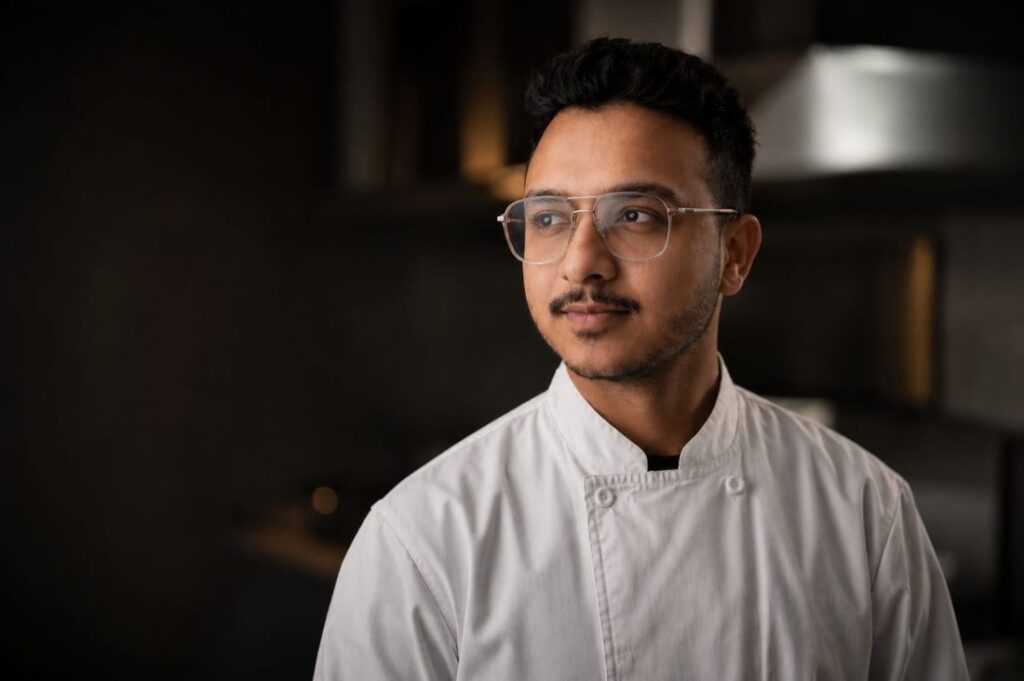
Ankish Shetty is corporate executive chef at Restaurant Associates (Compass Group) in New York City. He trained at Rasoi by Vineet—the Michelin-starred Indian restaurant in Geneva, Switzerland—and at the Kempinski Grand Hotel Des Bains in St. Moritz, Switzerland. His articles have been published in Nation’s Restaurant News, Restaurant Business Online and Chef to Chef, among other outlets. He serves as a jury member for Food in Space 2026 and publishes the newsletter Modern Indian Cuisine at Scale.
Subscribe to CFE News' twice-monthly newsletter reporting on the business of catering, foodservice and events.