By Sara Perez Webber
Julia Sweet didn’t build Gilded Tomato Company around sustainability because it was good marketing. She built it that way because it was how she already lived.
This April, Sweet’s lifelong approach earned her Rehoboth, Massachusetts-based catering company national recognition as the 2026 Greenest Caterer in America. The Green Restaurant Association (GRA) honored Gilded Tomato with the award after it earned 522.20 GreenPoints—the GRA’s scoring system for verified environmental actions across categories including energy, water, waste and food.
For Sweet, the award is the result of habits and values that took shape long before Gilded Tomato existed. Raised in a family that embraced careful use of resources—with an architect father who was an innovator in passive solar design—she brought her eco-conscious approach to the catering company she launched almost by accident in 2013.
Fired Up From the Start
The story of how Gilded Tomato earned more GreenPoints than any other caterer in the country starts with a cooking class.
Sweet’s husband Jon had taken a course in artisan bread baking in a wood-fired oven, taught by a Johnson & Wales instructor. He came home inspired, purchasing a large copper-clad oven on a teak bed. Soon Sweet—a former fitness educator who’s published a book on family fitness and nutrition—was taking it to farmers markets, serving up wood-fired pizzas with farm-fresh ingredients.
“Almost at our first event, people were saying, ‘Do you cater?,’” recalls Sweet. While that hadn’t been part of the plan, she dove right in.
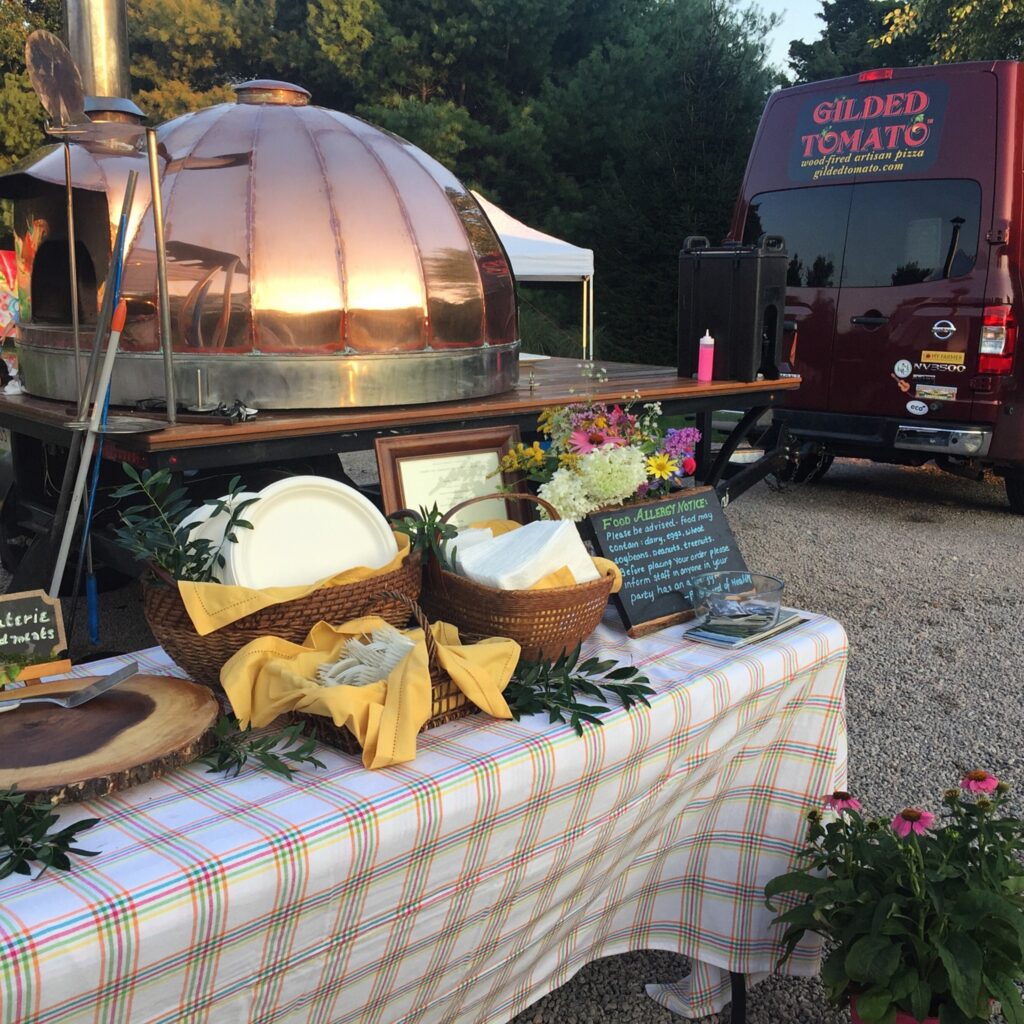
Thirteen years later, Gilded Tomato has built its identity around mobile, outdoor, wood-fired cooking, serving at venues ranging from Newport mansions to private backyards. The company brings two large copper-clad ovens—nicknamed Gatsby and Gilda—and Cowboy Cauldron firepits to events, where the cooking becomes part of the experience.
“Our whole emphasis is on wood-fire cooking,” Sweet says. “It’s primitive. It takes time. It’s lovely, with beautiful aromas and kiln-dried wood. It’s the joy of being outside in nature, for both staff and guests.”
When Live Fire Becomes an Icebreaker
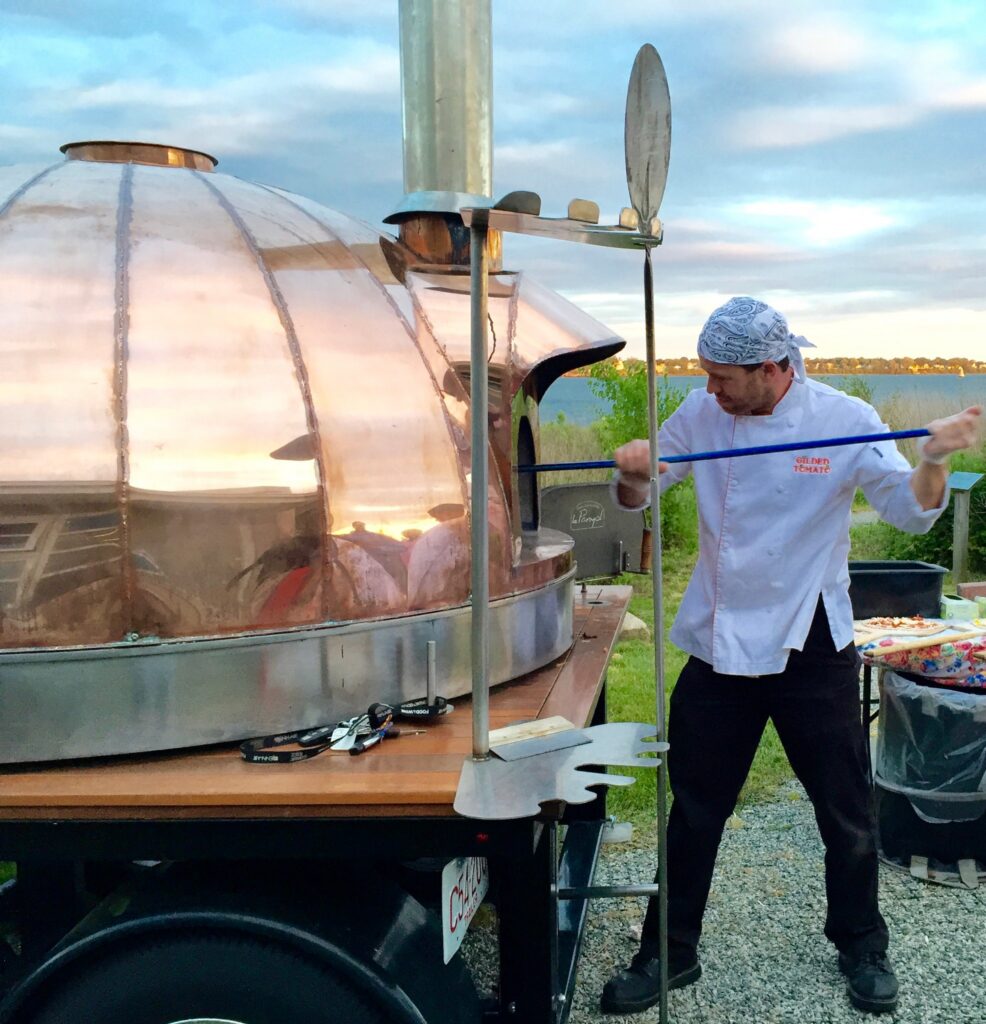
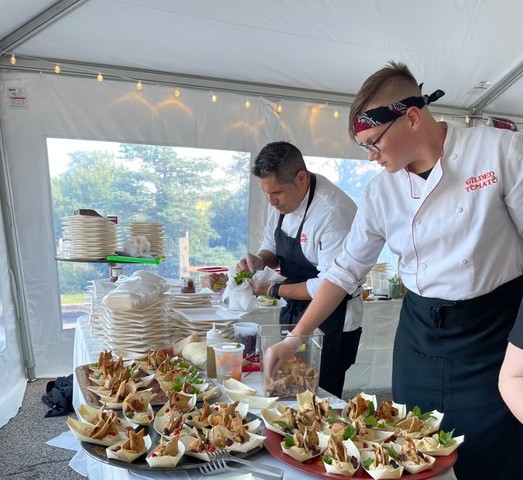
The live-fire element is central to Gilded Tomato’s appeal. Sweet describes it as “culinary entertainment,” with personable chefs cooking in front of guests, explaining the process as they go.
“People love that because it’s an icebreaker for their guests,” says Sweet.
Artisan pizzas are the centerpiece of the menu, with more than 50 varieties available—from Maine lobster to Chef Abe’s Peruvian Potato. The company has also continued to expand its culinary ambitions, recently bringing on James Beard Award nominee Andy Texeira as executive chef.
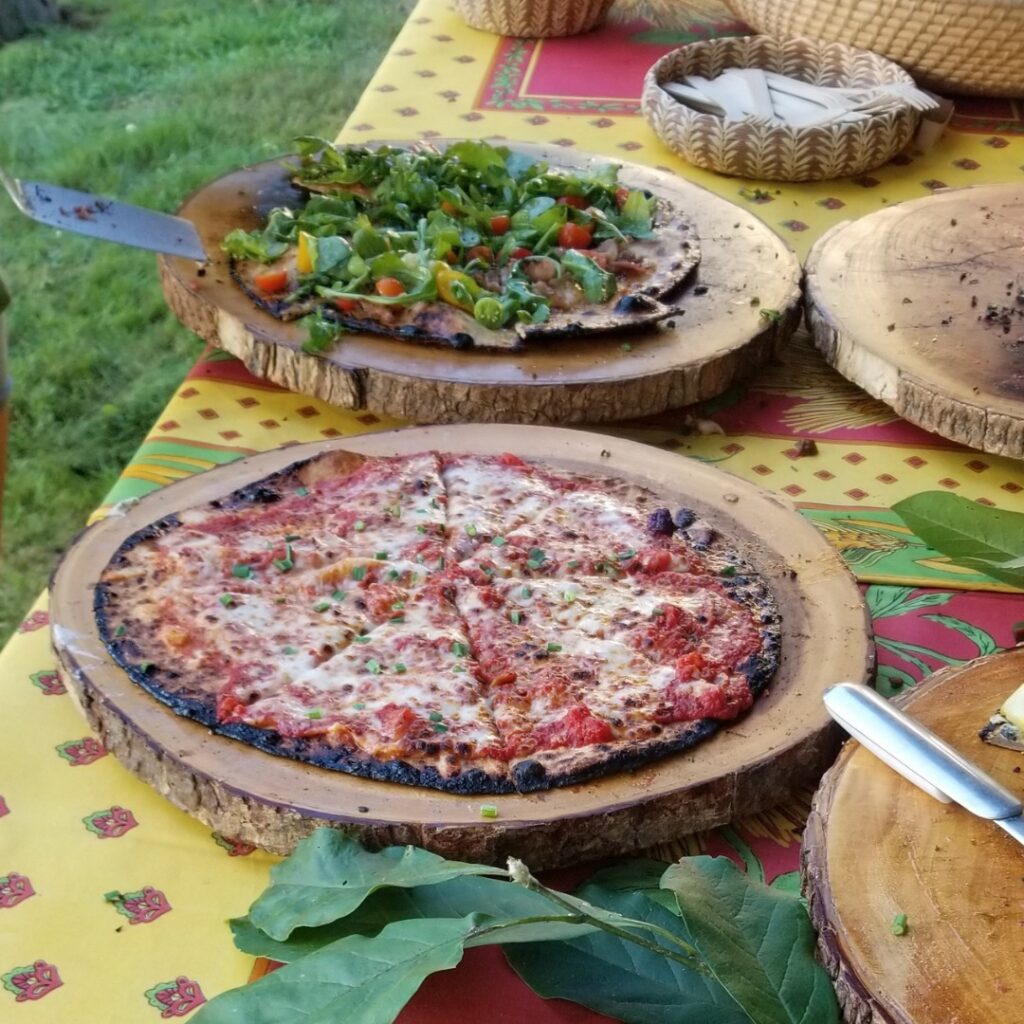
The wood-fired appetizers include such tempting choices as Grass-Fed Filet Mignon with Argentinian Chimichurri and Gilded’s Chicken Wings, flavored with raspberry, blueberry and chipotle. The dessert pizzas and wood-fired focaccia bread are a big hit, as are the colorful, bountiful salads—brimming with garden-fresh produce and herbs.
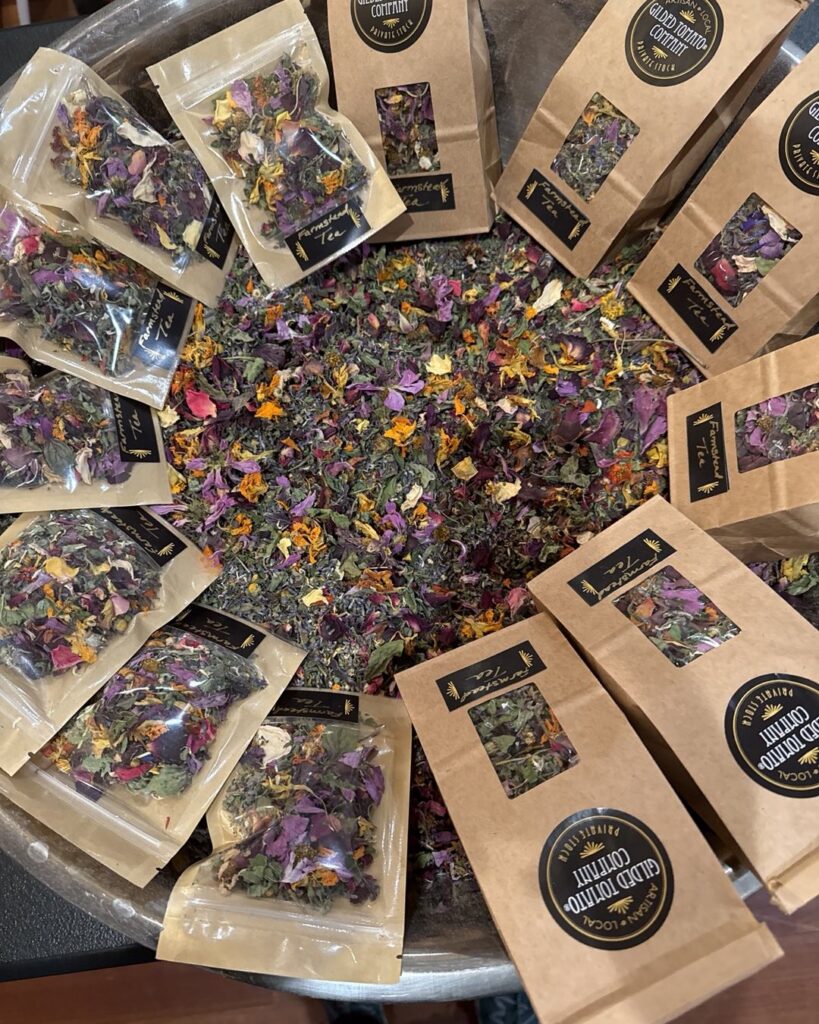
The company also makes jams, jellies, sauces, simple syrups and teas from ingredients grown or gathered on its farm.
“We just try to work on what we have, to present it beautifully and make it taste wonderful, and we try to hit all the senses,” says Sweet. “We sort of stay in our lane.”
Rooted in the Farm
That lane runs directly through Sweet’s property, the historic Whittaker-Peck Farm, which dates to the mid-1800s. Sweet even has a ledger of what the 19th-century Whittaker family produced as well as their recipe book.
“We live on a USDA farm, and we’ve always had a garden here, and that’s a critical part of what led to this award,” says Sweet.

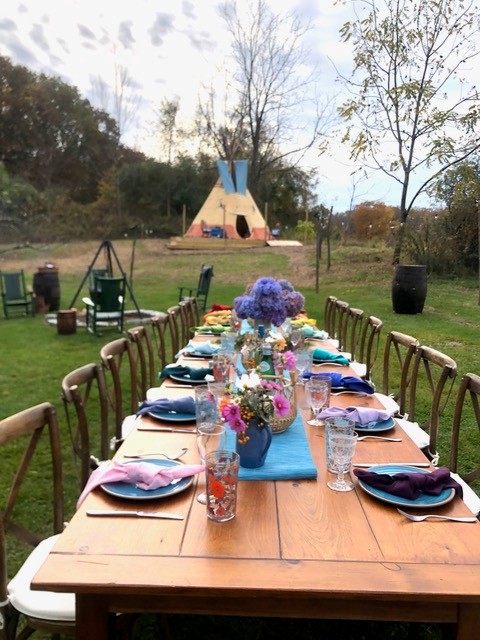
Today, the farm grows tomatoes, peppers, garlic, herbs, berries, edible flowers, honey and other ingredients used in Gilded Tomato’s menus. Recently the company has started hosting small events on-property—gatherings of up to 30 guests that include long outdoor tables and the use of a 26-foot-high Lakota Tipi.
“We change what we grow,” Sweet says. “The chefs have a say in what they want us to plant, and nature makes its decisions as to what’s going to grow and when.” The company also supports nearby farmers, including Rogue Lettuce, which grows six varieties of lettuce hydroponically.
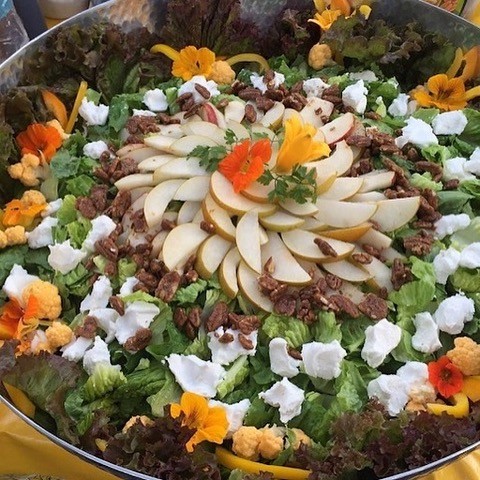
At Gilded Tomato, sustainability is a series of interconnected choices. Honeybees pollinate the gardens. Chickens provide eggs, pest control and manure. Eggshells go back to the chickens for calcium. Vegetable scraps go to the chickens or the compost. Berries become sauces and syrups. Herbs and edible flowers become teas.
“Everything that we do, we try to use full circle,” Sweet says.

Green by Design
Gilded Tomato has been a Certified Green Restaurant for years, but its certification level jumped from one-star to four-star when it became solar-powered. “That’s a large number of renewable energy points” in the GRA checklist, notes Sweet.
Gilded Tomato also uses biodiesel, electric vehicles, LED lights, compostable serviceware, reusable linens and salvaged materials. Linens are line-dried, when possible. The staff makes a natural antimicrobial and antibacterial cleaning solution out of pine needles, cedar branches, citrus and vinegar. If plastic bags are used, they’re washed, sanitized, drip-dried and used again.
When black walnut trees had to come down because they were shading the solar panels, the wood was sent to a sawmill and repurposed for farmhouse tables.
Sweet says part of her inspiration comes from the company’s longstanding connection to Johnson & Wales University. Gilded Tomato has employed many chefs and interns trained at the culinary school, and Sweet has ties with several faculty members. “We get a lot of ideas from their sustainability group,” she says.
The GRA’s lengthy certification process—which Sweet calls “impressive” and included inspections via FaceTime—helped the company organize and expand what it was already doing. The process gave Gilded Tomato a checklist to follow and a source for practical guidance.
For example, when Sweet’s compostable garbage bags were breaking easily and she had to use three at a time, she asked a GRA rep if it would make sense to use one regular bag instead. “It’s a nice place to get some feedback, and they’re really responsive in terms of answering questions,” she says.
Starting Small and Building From There
For other caterers looking to become more sustainable, Sweet recommends starting with the day-to-day details. Think about what you buy, what you throw away, what can be reused, what can be sourced locally and what small changes staff can realistically maintain.
“You sort of go through what your process is,” she says. “Do I need to purchase this? Is there another way to do this, and what would be something that’s better for the environment that I can contribute?”
Achieving the GRA’s top ranking was the result of a collective effort, notes Sweet. She credits Gilded Tomato’s chefs and staff, as well as nearby farmers, Johnson & Wales educators, neighbors and partners: “I couldn’t even begin to start naming all the people who have made it what it is.”

Sweet is careful not to frame sustainability as an all-or-nothing proposition, especially in an industry where operators are already balancing food costs, labor, rent and client expectations.
That may be the larger lesson from America’s greenest caterer. Sustainability doesn’t have to begin with perfection. It can begin with one decision, which leads to another and another.
“If every restaurant made just a handful of changes, we would save so much in the environmental impact,” Sweet says. “I don’t think it’s necessary for people to feel so stressed and overwhelmed and think that they have to become perfect right away. You do what you can do, and you make your impact.”
Subscribe to CFE News' twice-monthly newsletter reporting on the business of catering, foodservice and events.