Featured

Experts expect strong social event bookings in 2022.

Outlook for 2022

By all accounts, 2022 is the year of the comeback for the catering and events industry. Yet after a tumultuous 2020 and 2021, stumbling blocks remain—such as the ongoing labor shortage. To get a sense of where we are and where we’re going, CFE asked six industry executives to share what they’re seeing in the marketplace and where they predict we’re headed in the new year.

A vegan Buddha bowl from Kiss the Cook Catering in Toronto. Photo by Cuong Ly Photography

Plant-Based Revolution

Back in 2008, when Cristina Carolan launched Chef Veggie, her plant-based personal chef service in Austin, Texas, she admits, “It was a lot harder for me to find clients who would be happy with not having any animal products in their meals.”

Sarabeth Events is helping clients create big, fun-filled wedding celebrations.

Saying “I-Do’s” with Big To-Dos

Ring the bells and strike up the band—big weddings are back, and couples are getting ready to splurge as they tie the knot. “Our 2022 clients are ready to celebrate in a big way!” says Amy Ackerman, owner of JDV Occasions in Atlanta.

Bill Hansen Catering suggests creating a festive hot chocolate bar at an event.

Festive Feasting

It’s almost that time of year—when events are extra festive and the food extra indulgent. To help inspire your holiday menus, we asked caterers and chefs to share tips, strategies and recipes.

CF&E Training makes it easier than ever to ensure that staff members are properly and cost-effectively trained.

Introducing CF&E Training

This month, Catering, Foodservice & Events launches CF&E Training in partnership with Foodservice Training Portal. The catalog of 25-plus online, on-demand staff training courses for the foodservice and event industries makes it easier than ever to ensure that staff members are properly and cost-effectively trained—at a time when businesses may need it most.

Nearly three-quarters of consumers say they are willing to pay more for eco-friendly packaging.

Green Is Good

Your customers are most likely paying attention to whether the products you use in your business are environmentally friendly. According to a report by the World Wildlife Fund published in May, internet searches for sustainable goods worldwide increased by 71 percent in the last five years.

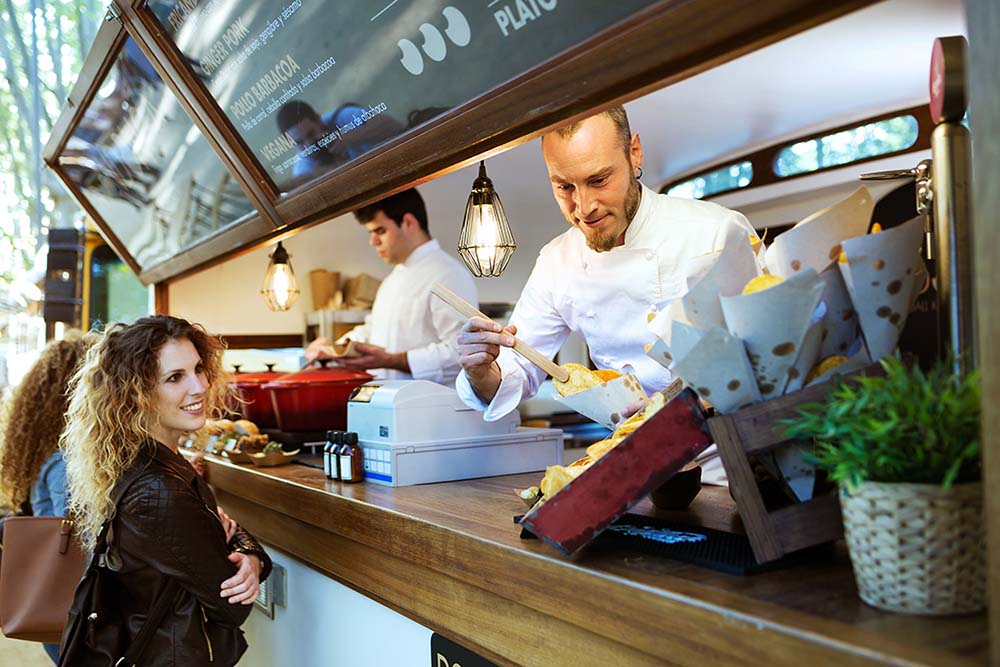
Being mobile helped many food trucks survive the pandemic.

On The Road Again

Have food, will travel. When it came to weathering the pandemic, being on wheels helped some food trucks stay in business. “Mobility is a huge advantage for food trucks,” says Ross Resnick, co-founder and CEO of Roaming Hunger, a booking marketplace for more than 18,000 food trucks in the U.S. and Canada. “They will go where the opportunities are.”

Tech Solutions

Many operational changes brought on by the pandemic are here to stay. That’s one of the findings of a recent study by Zenput—a tech platform that works with large restaurant and retail chains in operations execution solutions—and foodservice consulting firm Technomic.

The prepared meal market is growing.

Delivering the Goods

There’s no doubt about it—people will pay for convenience. The global meal kit delivery services market is expected to grow from $10.26 billion in 2020 to almost $20 billion by 2027, according to Grand View Research.

ChefReady features 10 individual kitchen spaces.

Trends: Four Reasons to Consider a Virtual Kitchen

At this time last year, the average eater or chef didn’t know much about virtual kitchens. Now, these often delivery-only concepts are popping up in almost every U.S. city and are slated to be a $1 trillion global market in the next 10 years.

Scroll to Top